.svg?sfvrsn=be606e78_3)
- Home
- Article
Bridging the Gaps
By: Carina Stanton | OSM Contributor
Published: 9/23/2025
Share:
Experts share how to pave new tech-driven communication pathways for a future-focused culture of safety.
Strong communication is the essential component in a perioperative culture of safety. It means clear, consistent and respectful interactions among all team members to strengthen collaboration and embed a sustainable safety culture into daily routines.
That sounds reasonably achievable, but execution is challenging when incessant conditions such as time pressures, distractions and inefficient systems get in the way. Taking an honest look at how to improve team communication in such a fast-paced, high-pressure, high-stakes environment is worth the effort, especially with the addition of artificial intelligence (AI) to the mix, according to AORN’s Senior Director of Evidence-Based Practice Lisa Spruce, DNP, RN, CNOR, CNS-CP, EBP-C, ACNP, FAAN, and Jeanine Watson, MSN, RN, CNOR(E), CASC, senior manager of AORN’s Ambulatory Surgery Division.
Data-driven technology
ASCs are increasingly leveraging data-driven tools such as electronic checklists, dashboards and AI-powered systems to enhance clinical decision-making and communication. Dr. Spruce says this is a great direction for outpatient surgery because “AI technologies can guide clinicians through standardized protocols and checklists in real time and embed evidence-based practices directly into the workflow, which promotes consistency, improves team coordination and minimizes variability in patient care.”
Dr. Spruce stresses, however, that technology in and of itself will not magically improve team communication. Perioperative leaders and teams must collectively understand and embrace how the technology can enhance and optimize communication.
Once that is accomplished, the challenge becomes standardizing technology-driven communication that is easy to use and can be scaled for future needs, says Ms. Watson. She believes that any communication technology your center adopts “should be able to grow with your ASC and integrate with other systems to support long-term goals, including strengthened daily workflows, enhanced team collaboration and a proactive culture of safety.”
Instill good communication
“Communication isn’t just a task. It’s a shared commitment that strengthens trust, reduces errors and ensures that every voice contributes to the best possible outcomes,” says Dr. Spruce.
She suggests these five actions that ASC leaders should ensure are established and practiced by all:
• Standardize safety conversations. Use checklists, briefings and debriefings to reduce variability, ensure critical information is shared and promote mutual understanding among team members. For example, “debriefings allow teams to reflect, learn and improve, and this continuous feedback loop strengthens safety culture over time,” Dr. Spruce notes.
• Establish a psychologically safe environment. Foster trust and open communication by creating an environment that allows all team members, regardless of role, to feel it is safe and encouraged to speak up about concerns, ask questions or report errors. Research demonstrates that when nurses and other team members feel empowered to voice concerns, adverse events decrease and team performance improves.
• Promote resilience. Enable individuals and teams to dynamically respond to unanticipated distractions, interruptions and disturbances. This resilience helps sustain a safe environment under conditions that could lead to failure, such as not recognizing early signs of patient deterioration or having tunnel vision during complex procedures.
• Focus on interdisciplinary collaboration. Work across disciplines to reinforce respect, trust and shared accountability for team-dependent work. This includes all members of the clinical team as well as those collaborating outside of direct patient care, such as for education and quality improvement.
• Take a zero-tolerance stance on disruptive behaviors. By disallowing unnecessary interruptions, dismissive attitudes or intimidation, leaders send a clear message that focus, respect and psychological safety are non-negotiable. “When distractions are minimized and voices are encouraged, teams can maintain situational awareness, prevent errors and respond quickly to emerging risks,” says Dr. Spruce.
Test the tech
Numerous exciting software programs and other technologies are available that ASC leaders can adopt to improve team communication and patient safety. The trick is to find the right fit for your team to ensure that the cost of the technology is worthwhile long-term.
As an ASC leader, Ms. Watson implemented several technology platforms that proved successful in improving team communication and promoting patient safety. She advises ASC leaders to look for programs and products that support the following functions:
• Streamline communication. Hands-free voice communication tools can connect teams instantly without disrupting their tasks. Secure text messaging and alerts can help ensure that sensitive information is shared safely and efficiently. Role-based calling can reduce delays by allowing staff to reach the right person simply by saying their name, role or group.
• Support staff with automated alerts on potential problems. Look for automated communication tools that facilitate situational awareness with advanced alerts to potential high-acuity events. Also, role-specific information-sharing can help teams coordinate an emergency response.
• Facilitate interoperability and scalability. Look for software platforms that are designed to grow with the organization and that integrate seamlessly with electronic health records (EHRs), nurse call systems and other healthcare-specific technologies. Also consider how communication technology integrates with devices such as smartphones, badges and tablets to offer more flexibility and reach when the tool is deployed.
• Provide usable data tracking and analysis tools. Dashboards can be great for this if they allow for tracking multiple patients’ throughput. Make sure each phase of care is tracked, including preoperative, ready for surgery, in the operating room, procedure closing, into PACU, and ready for discharge.
Managing communication upgrades
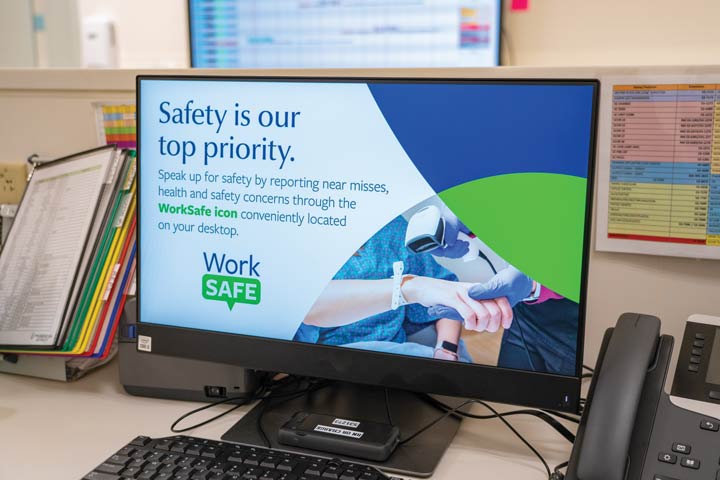
VISUAL AID Strategically placed visuals like the one shown here serve as powerful reminders of the role everyone plays in safe surgical care.
Focusing on team communication and implementing the right enabling technologies are powerful ways to embed safety culture into everyday perioperative practices and the teams that perform them, according to Dr. Spruce. She and Ms. Watson acknowledge, however, that taking those first steps to bridge communication needs with technology is not as simple as it may seem.
Step one, says Ms. Watson, is to consider how emerging technologies can replace manual processes while enhancing efficiency and safety. Many ASCs still rely on paper charting and documentation for regulatory compliance, which she says may seem cost-effective upfront but can limit your ability to track quality outcomes and ensure patient safety. “Paper records lack automated safeguards such as allergy alerts, medication interaction checks and real-time documentation — features that are standard in EHRs,” says Ms. Watson.
The next step is to target key moments of communication that can benefit from technological support. Dr. Spruce and Ms. Watson say there are two valuable places to start.
• AI-informed patient handoffs. Teams can be better prepared for a patient safety event when a patient safety risk is automatically flagged. For example, a properly designed AI tool can identify specific elevated risks for an individual patient, such as a DVT developing or a higher risk for fall during early mobilization, and trigger team discussion on this risk in a more standardized communication chain across each phase of patient care.
Dr. Spruce advises that when applying an AI tool, nurses and other members of the team must be involved in its development and implementation to ensure the data tracked are relevant and easy to share. She suggests teams target these areas to optimize an AI-informed handoff:
Include relevant data. Only information that is meaningful to the care team should be collected. Involve key stakeholders in the handoff tool design.
Incorporate evidence-based practices. The AI tool must support proven strategies, such as announcing the handoff, to enhance clarity and accountability.
Reference existing tools. Build upon validated handover instruments to maintain consistency and leverage best practices.
Utilize the EHR. Integrate the EHR to automatically generate patient-specific data and risk reports that support safer transitions.
• Automated near-miss tracking. ASC leaders who still use a manual process for tracking patient safety occurrences need to think through their business case to purchase an occurrence tracking system, says Ms. Watson. She worked through this process when she implemented an occurrence tracking system in her ASC and found operational, clinical and patient experience benefits.
Explore the Evidence on Communication, Technology and Safety
In addition to revisiting best practices from the AORN Guideline for Team Communication, Dr. Spruce suggests ASC leaders explore these research articles that highlight the rationale behind improving communication to drive a stronger safety culture:
1.) “Effect of Increased Interprofessional Familiarity on Team Performance, Communication, and Psychological Safety on Inpatient Medical Teams: A Randomized Clinical Trial.” JAMA Internal Medicine, 2022: osmag.net/familiar
2.) “Investigating Teamwork in the Operating Room: Engaging Stakeholders and Setting the Agenda.” JAMA Surgery, 2017: osmag.net/teamwork
3.) “Potential uses of AI for perioperative nursing handoffs: A qualitative study.” JAMA Open, 2023: osmag.net/handoffs
For example, the system integrated with her EHR and streamlined the reporting and tracking of near-miss events and occurrences by collecting and analyzing safety events for common themes, outliers and gaps in processes. “Patient complaints and negative feedback from post-op phone calls were entered into the system when appropriate to identify opportunities to improve patient satisfaction,” she says.
Here is what Ms. Watson says you should highlight to make the business case for automating safety occurrence tracking: It creates a centralized depository for all safety occurrences throughout the facility; provides real-time alerts to notify the appropriate department when an incident is logged; offers actionable data to uncover patterns and trends with safety events throughout the facility; categorizes occurrence by type to accurately show themes or trends in certain areas.
As complexity of care delivery and reporting requirements continue to deepen, both Dr. Spruce and Ms. Watson say investing in an EHR is one of the most impactful steps an ASC can take to streamline communication across teams and support accurate data collection for quality improvement and regulatory reporting.
“While budget constraints are a reality for many ASCs, technology implementation can be phased in strategically, starting with areas that address the most pressing operational challenges,” says Ms. Watson. OSM
.svg?sfvrsn=56b2f850_5)