.svg?sfvrsn=be606e78_3)
- Home
- Article
Instrument Care Training That Sticks
By: Carina Stanton | Contributing Editor
Published: 9/9/2024
Share:
Target deficiencies by educating staff to reinforce safe practices across your ORs and your SPD.
It takes a team to ensure surgical instruments are clean, sterile and ready for surgery. It also takes heart from frontline workers to band together for the common cause of patient safety. Finally, a crucial component of this mission requires leadership to shape staff education programs that describe and reinforce best practices in instrument care.
Interdepartmental issue prevention
These cornerstones of instrument care may sound obvious, but a consistent, comprehensive and well-coordinated team response is a constant challenge for many facilities. HOPDs and ASCs face instrument-related quality control issues daily, including finding bioburden on sterile instruments, incomplete trays and holes in sterile wrap. These issues snowball into instrument delays, which leads to surgery delays, frustrated patients and overwhelmed staff who wind up blaming sterile processing for everything. That’s why instrument care is paramount to the health of your facility.
Instrument care issues can impact patient safety and delay case starts, says Donna Lagasi, RN, BSN, MS-HCM, CNOR, assistant vice president of interventional services at The Valley Hospital in Paramus, N.J. “Our instrument care challenges had become the root cause of safety issues and delays that created stress and strain between the OR and SPD teams, often leading to blame and frustration,” she says.
• Take a deep dive. Adding staffing shortages to these existing instrument care challenges brought The Valley Hospital to a breaking point while Ms. Lagasi and OR Clinical Specialist Bonnie Weinberg, MSN, RN, CNOR, were preparing their perioperative teams to move to a new facility. To avoid bringing old issues to their new space, they convened a team to start identifying long-lasting solutions for instrument quality and teamwork centered around assessment, communication and education. Regularly stepping back and looking at your instrument care processes and corresponding team communication from 30,000 feet is a good exercise whether things are working or are in desperate need of improvement.
• Bring the right team to the table. With a big-picture mindset, Valley created a new OR/CPD committee tasked with reviewing pain points and missed opportunities, as well as celebrating solutions to their instrument care concerns.
Surgical technologists and central processing coordinators topped the list of experts asked to join the team. Nurses, educators and managers from both central processing and the OR were also invited.
“While the immediate goal for this committee was to tackle instrument quality concerns, one lasting benefit has been stronger communication and collaboration between the OR and sterile processing,” says Ms. Weinberg.
Helpful Tips
Five Areas for Improvement in Instrument Care
Leaders at The Valley Hospital in Paramus, N.J., recommend the following interventions that can help improve instrument care and, by extension, patient safety.
• Improve instrument tray set-up. To reduce damage to wrapped instrument sets, preference cards should be updated to reduce the chance that your SPD staff will be reprocessing instruments that were never actually used during the procedure. Also consider adding shelf lining, bumpers and foam wrapping to heavier trays. At the hospital’s outpatient center, pink wrap is added outside of blue wrap to identify loaner instruments.
• Prioritize back-table instrument care. Used instruments should be cleaned with water on the back table during the procedure and sprayed at the end of the case. Immediate-use steam sterilization should be eliminated. The addition of dedicated training and visual reminders in the OR can improve adherence to this point-of-use treatment for instruments. Informal “circle-up” meetings of the OR team can further aid in keeping issues that may occur from spiraling, and help re-engage the team if needed.
• Dial in the right enzymatic spray. Through direct real-time communication, frontline staff at The Valley Hospital shared concerns with leadership about how the instrument spray they were using to pretreat instruments in the OR was aerosolizing. Further investigation found the spray was not enzymatic. After trialing different products as a team, they found a non-aerosolizing enzymatic spray that has improved instrument care in the OR.
• Huddle up. The Valley Hospital added a 6:15 am huddle for OR and SPD staff to talk through potential issues for that day, such as a tray shortage for the number of cases. “This added huddle helped us be more efficient at our 10:15 a.m. and 1:30 p.m. huddles, where we plan and then confirm needs for the next day,” says Ms. Weinberg.
• Arrange SPD tours for surgeons. By following instruments through their reprocessing journey, they appreciate how meticulous, busy and intense sterile processing can be. “It helps surgeons gain a better understanding of what it takes to get just one instrument to the OR,” says Ms. Weinberg.
—Carina Stanton
• Right-size staff and workloads. The first order of business was to take a hard look at the central processing department’s staffing levels and workload. The committee recognized that the department was understaffed and overworked. Temporary workers were filling staffing gaps, which added to the inconsistency of instrument care practices. Meanwhile, an overreliance on central processing staff to handle all equipment and instrument cleaning activities for the hospital was stretching a thin team even thinner.
The committee employed the Spaulding Classification to target where certified central processing staff were needed most to sterilize and disinfect instruments. Non-critical cleaning and disinfection tasks were taken back to the floors with dedicated training for point-of-use treatment. From this point on, they renamed central processing the sterile processing department (SPD) to better reflect it’s scope of work.
Next, they tackled staffing vacancies by creating an externship program to educate, train and certify in-house personnel to be SPD team members.
Leaders also created a quality sheet for every case cart to collect data from both the OR and SPD for a two-week period.
The goal was to learn more about instrument-care concerns and to establish a baseline for improvements. More than 1,000 trays were surveyed with the top issues identified including holes in blue wrap, instruments in the wrong trays, broken instruments and bioburden on instruments. “We also learned that some of our scrubs weren’t properly spraying instruments at the point of use,” says Ms. Weinberg.
Staff education
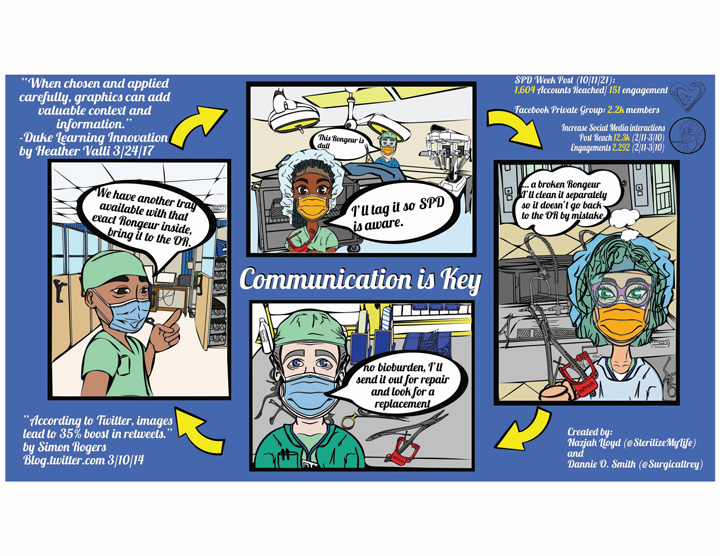
TOON TIME A poster on proper communication hangs in Valley’s SPD to reinforce correct instrument processing practices.
The data collected and analyzed from the quality sheets provided a roadmap for action that started with additional training for team members in the ORs and the SPD. Some of the curriculum overlapped. “While individual tasks differ, the end goal is the same, so we worked to bridge learning goals for all teams,” says Ms. Weinberg.
The Valley Hospital’s SPD Educator Dannie Smith and SPD Manager Amina Omar found that the following three best practices made their instrument care training stick.
1. Make training relatable and reinforce it visually. How-to videos and presentations complement hands-on training to correct practices such as point-of-use treatment in the OR. They are easy to share as friendly reminders for reinforcement.
Ms. Weinberg adds that sharing relatable analogies, such as equating the hardened bioburden left on used instruments to food particles stuck on dirty dishes left in the sink overnight, help. Using that analogy, it becomes clearer to staff that it’s much more time-consuming to clean instruments if they haven’t been pretreated with moisture. Hanging posters in the SPD that depict instrument-care best practices also helps keep the mission and strategies top-of-mind among staff.
2. Round for influence. Regular rounding by OR and SPD leaders enables them to collaborate with staff to address problems and deficiencies in real time. Concerns are brought to leadership so a corrective plan can be developed and enforced.
3. Bring in the reinforcement. Because adherence to correct practices can easily wane over time, especially if surgical volume or delays unrelated to instrument care crop up and increase workflow pressure, reinforcement of instrument-care education among OR and SPD employees will set up both sides for success. OSM
.svg?sfvrsn=56b2f850_5)