.svg?sfvrsn=be606e78_3)
- Home
- Article
Sharpened Focus
By: Jared Bilski | Editor-in-Chief
Published: 9/23/2025
Share:
From policy overhauls to protocol changes, here’s how facilities keep staff safe from cuts and needlestick injuries.
More than two decades after the landmark Needlestick Safety and Prevention Act was passed in 2000, approximately 385,000 sharps-related injuries still occur in healthcare settings annually, according to the CDC.
It’s a stat that effective facility leaders use to keep sharps safety top-of-mind with staff, and a means of anchoring regular training and education on this critical area of safe surgical care that, no pun intended, sticks. Despite progress and technological advancements such as safety scalpels, blunt-tip suture needles and a variety of passing/transfer trays, sharps injuries continue to occur inside the OR and in sterile processing departments.
That’s not to say that products on the market can’t be extremely effective at reducing and preventing injuries. They just need to be the right products for your team. And the best way to know for sure is to get feedback straight from staff on the front lines. For instance, a facility featured in a previous issue of Outpatient Surgery Magazine assigned a team of surgical staffers to a “Sharps Committee” that assessed products that promote sharps safety. The committee trialed new products and also encouraged staff to bring forward products they discovered to the committee to see if they were worth pursuing.
Problem spotting
Preventing sharps injuries ultimately comes down to following best practices — what staff is or isn’t doing safely. On the most basic level, they must first be aware of their vulnerabilities.
“The common mistakes that result in needlesticks and sharps injuries include improper disposal, inconsistent policy enforcement and lack of education,” says Jennifer Parrott, RN, CNOR, clinical nurse educator, quality improvement manager and sterile processing department manager at Knoxville (Tenn.) Orthopaedic Surgery Center.
A multilayered protocol that includes the use of neutral zone passing, a designated area for staff members to pass sharps, safety scalpels, double-gloving and blunt-tip suture needles goes a long way toward preventing injuries. So does an effective sharps disposal process. Regularly monitor sharps disposal bins to make sure they aren’t overfilled, something that could heighten the problem the bins are meant to prevent.
Effective sharps safety practices start with a clear, consistent policy that transfers from paper to practice. “Have a purpose and scope, outlined roles and responsibilities, training and education, safe-handling procedures and a strong incident reporting system,” says Ms. Parrott. “Holding each other accountable is key and regularly reviewing annual policies is vital to address any challenges.”
Revise and reeducate
Sometimes sharps safety improvements require facilities to step back, reassess their procedures from a 30,000-foot view and refocus their efforts. Such was the case with Virtua Health, a process outlined in a poster presented at the 2025 AORN Global Conference and Expo by authors Lori Kraus, BSN, RN, CNOR, and Kathleen Adams, MSN, RN, CNOR.
In the poster, the authors described their efforts, in collaboration with the vice president of surgical practice and outcomes, to create interdisciplinary awareness at the surgical field, specifically through use of the “neutral zone.” The facility revised its current sharps policy to help improve compliance and reduce injuries, and developed a yearly competency for its sharps safety policy and procedures in accordance with AORN standards.
The facility reeducated staff on its current policy and educated staff how to make a “safe zone” with the mayo stand and back table, reinforced communication with the surgeon on the safe zone location on the sterile field, and detailed how to use a hands-free passing system. It also audited its compliance with its use of the neutral zone and safe handling of sharps, finding staff was non-compliant at least 85% of the time.
The results of the facility’s focus on sharps safety were dramatic, particularly when the audit results were presented to staff. “This prompted awareness to the potential harm, thus creating appreciation to comply with sharp safety skills. There was almost immediate conformity among the staff,” wrote the poster authors.
“Reinforcement of the policy will be ongoing. Quarterly evaluations will determine if the sharps injuries decrease. The goal will be to have zero reported injuries.”
GUIDELINE UPDATE
2025 AORN Guidelines Includes Important Sharps Safety Addition
AORN recently published an update to its Guideline for Sharps Safety, which includes a new recommendation (recommendation 1.1) to organize a formal program for reducing sharps injuries in the perioperative setting.
The recommendation was included in the 2025 edition of the AORN Guidelines for Perioperative Practice, which you can find more details about by visiting osmag.net/sharpsrecommendation.
Inadvertent sharps in SPD
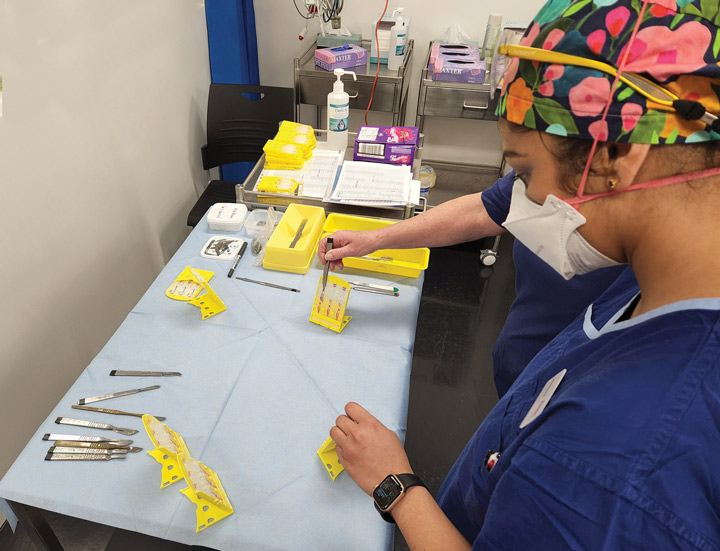
CONTINUING EDUCATION Identify fresh ways to educate staff on best safety practices and consider making sharps training an annual competency.
While sharps safety often conjures up images of needlesticks in the OR, sterile processing professionals are far from immune. Another sharps safety poster from the 2025 AORN Global Conference and Expo, authored by Mayo Clinic’s Brandy Luoma, RN, CRCST, division of surgical services, outlined how a team consisting of a sterile processing RN resource specialist, SPD supervisors, surgical services nurse managers and surgical services-allied health staff teamed up after discovering an increase in the quantity of sharps inadvertently entering the decontamination space of SPD. A team set out to reduce the number of inadvertent sharps entering that space by 50% over a six-month period through improved incident reporting, follow-up and education.
To achieve this goal, the facility created a quality feedback program within its instrument tracking system, gathered and analyzed baseline sharps data and disseminated that data to leadership and perioperative staff via high-level reports posted on huddle boards for discussion.
“Through reporting, we are able to accurately track sharps involved in the events and have implemented a system to provide feedback to nurse managers,” wrote Ms. Luoma in the poster. “Feedback includes information on the sharp type, origin and staff involved in the event. Nurse managers expediently follow up and provide individualized education for staff, as well as continuing education with all staff within the department.” The combination of accurate tracking and analysis paired with timely education did the trick. After a six-month reporting period, the quantity of sharps entering decontamination reduced by 52% in occurrence per case.
The big picture
Revisiting policies and procedures regularly, creatively using new data, incident reports and the latest literature, as well as finding fresh ways to educate and reeducate staff on best practices to ward off complacency, are proven tactics in the never-ending journey to prevent sharps injuries. It’s everyone’s responsibility — from frontline staff to executive leadership — to keep sharps safety top-of-mind.
That only happens when staff feel supported and understand the big picture. “It is imperative to have a strong culture of safety. Make sure your team has a voice and is not fearful to speak up,” says Ms. Parrott. “By creating a culture of safety, you are empowering your team and giving them a voice.” OSM
.svg?sfvrsn=56b2f850_5)