.svg?sfvrsn=be606e78_3)
- Home
- Article
Update on the Whole Room Disinfection Market
By: Outpatient Surgery Editors
Published: 10/8/2025
Share:
Improvements in technology and new 510(k) clearances are bringing new platforms to the masses.
Should they choose to buoy their meticulous surface disinfection practices with adjunct technology, facilities have multiple whole room disinfection options available.
There are UV lights, hydrogen peroxide vapor systems, ultraviolet germicidal irradiation (UVGI) technology, 405 nm lights and continuous action disinfection (CAD) products. Facilities can also apply disinfectants with electrostatic sprayers. OSM has covered these technologies in detail (osmag.net/wholeroom).
Dynamic market
While whole room systems are typically viewed as hospital-based platforms, the tide seems to be turning. The whole room disinfection market has grown significantly, especially when it comes to one particular technology.
“The UVC market has been pretty dynamic in recent years, especially in response to the COVID-19 pandemic,” says Mairead Smith, principal project engineer for ECRI, a healthcare safety consultancy headquartered in Plymouth Meeting, Pa. “Improvements in UV-LED technology are changing the types of UV products that can be offered.” Ms. Smith also points to ongoing research into Far-UVC technologies that focused on exploring and expanding applications in occupied spaces. “A few whole room UVC products have now received 510(k) clearance by the FDA for reduction of microbial load on medical device surfaces — this represents a new development since FDA created the new product classification in 2023.”
UVC
Ms. Smith points to several compelling benefits of UVC for facilities looking to invest. “UVC technologies can perform no-touch disinfection cycles that can reduce bioburden across many surfaces and in the air. The cycles have a relatively quick turnaround, they are generally easy to use, and applications can be very flexible,” she says.
For many facilities, that’s exactly what they’re looking for. “I think the areas of greatest interest for healthcare facilities will be technologies that can be operated in the background without requiring staff labor and that can demonstrate meaningful improvements to patient and staff safety,” she says.
Still, current UVC systems do require some staff labor for effective use and extra time for room turnover, and some decision makers may also have concerns about cost and the overall safety of the platform. These are the core reasons Ms. Smith believes facilities opt to forgo UVC systems as an adjunct to their manual surface disinfection processes. “These may be surmountable challenges, but they place an additional burden on the staff to manage the equipment proactively,” she says. “In addition, exposure to UVC can degrade materials such as plastics over time.”
Compared to hydrogen peroxide vapor (HPV) systems, Ms. Smith says UVC technologies tend to achieve a lower overall reduction in pathogens, but they have one key advantage over HPV that matters a lot to high-volume centers: “They have a faster turnaround.”
BEFORE YOU BUY
What to Ask Vendors Before Investing in Whole Room
When trialing whole room disinfection systems at your facility, come to the table armed with questions for the vendor rep that will give all the information needed to make a carefully informed decision.
To that end, Mairead Smith, principal project engineer for ECRI, a healthcare safety consultancy headquartered in Plymouth Meeting, Pa., offers some suggestions on the types of questions that will yield the right information during those critical conversations with prospective vendors. While these were geared toward potential UVC systems, the universal appeal of these questions will work for any whole room system you’re interested in (unless otherwise noted).
For efficacy:
• What are the germicidal wavelength(s) used by your device? What is the evidence for the efficacy of this wavelength against the pathogen(s) of greatest interest to the facility? (for UVC systems)
• What is the evidence for your device specifically?
• What is the evidence that your device reduces infection rates?
For ease of use:
• What is a typical cycle time for using the device in rooms of interest at the facility (e.g., patient rooms, ORs)?
• How many device locations are recommended in each room?
• How much staff involvement is needed to implement this device effectively?
For safety:
• What safety features are incorporated into the device/platform?
• Does it use door sensors, motion sensors or something else?
• How does it prevent activation by unauthorized users?
Hydrogen peroxide vapor
HPV systems are the other major player in the whole room market. These systems use 35%–59% hydrogen peroxide solutions that are EPA-approved chemical sterilants and SARS-CoV-2 disinfectants, according to Amanda Sivek, PhD, a-IPC, principal project engineer for ECRI. “HPV decontamination systems disperse approximately 57–400 parts per million HPV to decontaminate porous and nonporous surfaces within an enclosed, unoccupied space and break down HPV into water vapor and oxygen after the required contact time,” says Dr. Sivek.
There are many benefits to HPV systems, which can be used with compatible porous and nonporous surfaces, says Dr. Sivek. “If properly dispersed, HPV reaches all porous and nonporous surfaces within an enclosed space within one cycle,” she adds. “Moreover, effectiveness is not affected by physical constraints or shadows.” But Dr. Sivek points out some downsides, including the possibility that equipment may be damaged from HPV use, and the fact that additional staff training is required for use. Plus, there’s the time element. “The HPV decontamination cycle lasts several hours, prolonging room turnaround time,” she says. “Rooms undergoing HPV decontamination must be temporarily sealed to prevent escape of HPV.”
Manual is a must
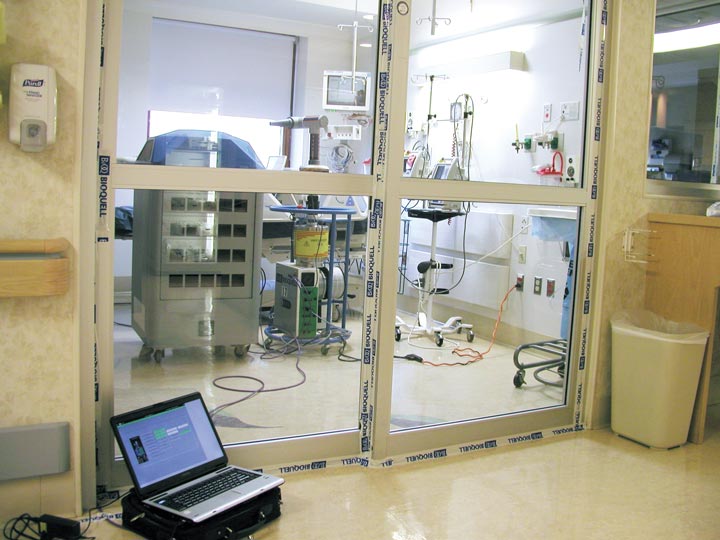
SIGNED, SEALED, DISINFECTED Hydrogen peroxide vapor effectively sterilizes operating rooms, but the doors and air vents must be closed first.
Before you delve into determining the right technology, make it clear to leadership and staff what whole room disinfection is and what it is not.
“Know that this technology won’t ever replace the manual cleaning that must happen in between procedures or at the end of the day, but it can offer an enhanced layer of additional disinfection protection to your repertoire,” Benjamin D. Galvan, MLS(ASCP), CIC, CPH, director of infection prevention at HCA Florida South Tampa Hospital, told OSM.
Mr. Galvan understands that cost concerns will always pop up — as they should. “Being fiscally responsible is a core part of infection prevention. It’s impossible to eliminate every risk, but we must regularly evaluate the ways we can improve our processes,” he said. “A strong cost-benefit analysis will help you weigh the pros and cons of any new technology.” That analysis should weigh the cost against the benefits of preventing healthcare-associated infections and create a clearer picture of when it’s time to add whole room disinfection to your standard surface cleaning protocols.
“If your facility is seeing environmental transmissions for MRSA, C. diff or other organisms, it’s worth your time to consider bolstering your processes and your supplemental cleaning options,” said Mr. Galvan. OSM
.svg?sfvrsn=56b2f850_5)