
The Evolution of the Heart Valve
By: Sara Angelilli, DNP, MS, RN, CNOR, NPD-BC
Published: 4/17/2025
Share:
The first mechanical heart valve device was created and implanted by Dr. Charles Hufnagel in 1952. Dr. Hufnagel’s first valve surgery was different from today’s technique because the valve was placed in the descending thoracic aorta.1 In 1960, Dr. Dwight Harken was the first surgeon to place a mechanical caged ball valve in the subcoronary position to treat a patient with aortic stenosis.1 The prosthetic cardiac valve has transformed from the early mechanical caged ball design into today’s modern-day implants through about 70 unique designs.1
Indications for Aortic or Mitral Valve Replacement
Cardiac valve replacement surgery is one option for mitral stenosis, mitral regurgitation, aortic stenosis, or aortic insufficiency/regurgitation.2 Valve stenosis is a narrowing of the valve opening caused by rheumatic fever; calcification; or in the case of aortic stenosis, a congenital bicuspid valve.2 Mitral valve regurgitation occurs when blood flows back into the left atrium because the valve leaflets do not properly close. Aortic insufficiency occurs when blood flows back into the left ventricle because the valve leaflets do not properly close.
Table 1. Summary of Aortic and Mitral Valve Disease2
| Disease | Definition | Causes | Effects | Symptoms |
| Mitral stenosis | Narrowing of the valve opening that limits blood flow out of the left atrium | Rheumatic fever | Increased pressure in the left atrium, dilation of the left atrium leading to pulmonary hypertension, right ventricular hypertrophy, or tricuspid valve regurgitation | Dyspnea, fatigue, orthopnea, pulmonary congestion, right ventricular failure |
| Mitral regurgitation | Improper closure of the valve leaflets that allows blood to backflow into the left atrium | Posterior leaflet prolapse, myxomatous degeneration, secondary result of aortic valve stenosis, dilated cardiomyopathy | Dilation of the left atrium | Dyspnea on exertion, easy fatigability |
| Aortic stenosis | Narrowing of the valve opening that limits blood flow out of the left ventricle | Rheumatic fever, congenital bicuspid valve, calcification | Increased pressure in the left ventricle, left ventricular hypertrophy | Fatigue, exertional dyspnea, angina pectoris, syncope, congestive heart failure |
| Aortic insufficiency | Improper closure of the valve leaflets that allows blood to backflow into the left ventricle | Rheumatic fever, aortic root disease, calcification, infective carditis | Increased pressure in the left ventricle, left ventricular hypertrophy | Bounding pulse, syncope, fatigue, palpitations, dyspnea on exertion |
Mechanical Caged Ball Valves
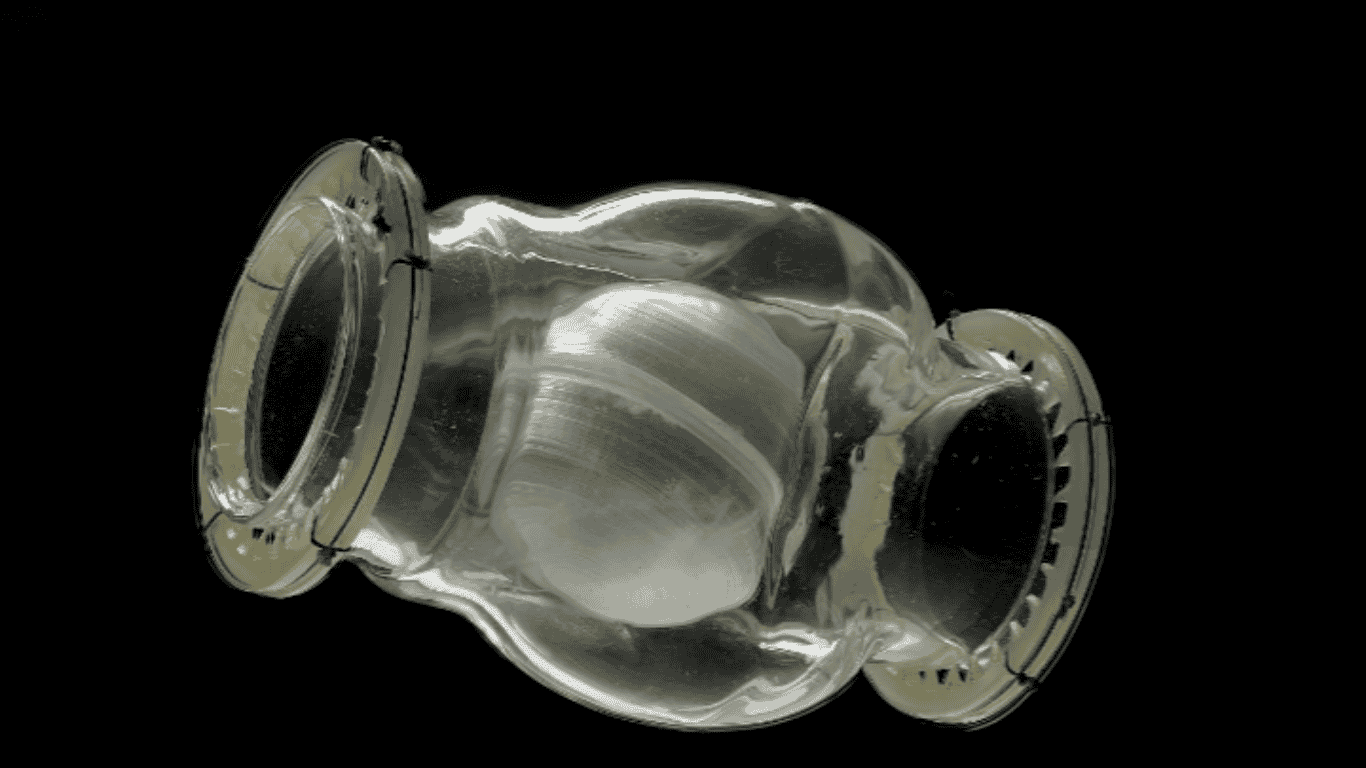
The first mechanical valve replacement surgeries used a variety of caged ball designs, including the Hufnagel Ball Valve, the Starr-Edwards Ball Valve (Figure 1), and the Magovern-Cromie Ball Valve.1 In many cases, a cardiac surgeon partnered with an engineer to design the mechanical valve. While the devices are durable, the design is bulky, turbulence is introduced into the blood flow, and there is a risk of thrombosis and bleeding.1 Operative mortality rates for the early mechanical valve replacement surgeries were between 15% and 20%, which is confounded by evolving perfusion technology during the same timeframe.1 The Magovern-Cromie ball valve introduced suture-less fixation, which decreased cardiopulmonary bypass duration and mortality rates.3 The concept of suture-less fixation would later be adopted with bioprosthetic valve designs.
Figure 1. Hufnagel Intracardiac Valve
Today’s Cardiac Valve Replacement Options
Today’s prosthetic valves include mechanical tilting disk, mechanical bileaflet, biologic heterograft, biologic allograft, and transcatheter heterograft valves. The physician will select the appropriate valve implant based on patient and valve characteristics, including hemodynamics, thromboresistance, durability, ease of insertion, anatomic suitability, patient acceptability, cost, and patient treatment goals.2 Operative mortality rates for valve replacement surgeries range between 1% and 2%, with low lifetime complication rates.1 Table 2 provides a comparison of mechanical and bioprosthetic valves.2
Table 2. Comparison of Mechanical and Bioprosthetic Valves2
| Valve | Construction | Advantages | Disadvantages |
| Mechanical | A single or bileaflet tilting disk design |
|
|
| Bioprosthetic* | Porcine, bovine, equine, or human tissues |
| Type-dependent but may include
|
*May be preserved in gluteraldyde solution; each manufacturer provides specific instructions for rinsing the tissue before implant.
References:
- Gott VL, Alejo D, Cameron DE, Mechanical heart valves: 50 years of evolution. Ann Thorac Surg. 2003;76(6):S2230-S2239. doi:10.1016/j.athoracsur.2003.09.002
- Rothrock JC. Alexander’s Care of the Patient in Surgery. 17th ed. Philadelphia, PA: Elsevier; 2023.
- De Martino A, Milano AD, Barbera MD, et al. The Caged-Ball Prosthesis 60 Years Later: A Historical Review of a Cardiac Surgery Milestone. Texas Heart Inst J. 2022;49(2): e207267. doi:10.14503/THIJ-20-7267
