AORN CineMed Video for Perioperative Staff Education
- Home
- Education
- Education for Facilities
- AORN CineMed Videos
How does AORN CineMed video enhance perioperative staff education?
Educators can’t be everywhere. Video can.
Here we explain how AORN CineMed Video enhances perioperative staff education and helps nurse educators provide quality CE for staff in and around the operating room. It is intended for nurse educators, perioperative nurses, and surgical team leaders seeking effective, evidence-based training solutions. Understanding the benefits of video-based education can help improve staff competency and patient safety.
Key Takeaways:
- AORN CineMed video is evidence-based CE on surgical patient and staff safety, developed by AORN nurses, built on the AORN Guidelines for Perioperative Practice.
- Features 40+ in-depth video courses with 50+ contact hours awarded on completion.
- Every course includes a study guide and posttest; educators assign and track completion—and it offers reporting for documentation.
- Provides 165+ quick reference Perioperative Clips for just-in-time learning.
How video-based education enhances perioperative staff education.
A perioperative educator's time is in high demand—but they can only be in one room at a time for hands-on training. And complex perioperative topics are often best taught through demonstration.
That's what AORN CineMed was built for: it extends an educator's reach, so the team keeps learning even when the educator can’t be in the room—with education that shows best practice, done by the book, by real clinicians in real clinical settings.
What does AORN CineMed offer?
AORN CineMed is evidence-based continuing education on surgical patient and staff safety, developed by AORN. It offers 40+ in-depth video courses, with 50+ contact hours in total, awarded on completion of the courses and evaluations. Every course includes a study guide and a posttest to assess competency. Educators can assign courses, set due dates, and track completion for each learner.
Just-in-Time Learning
AORN CineMed also offers 165+ quick reference Perioperative Clips. With mobile-optimized content, these shorter videos are ideal for just-in-time learning. Learners get evidence-based practices demonstrated by experienced clinicians—it's education right when it's needed.
Audience and Use Cases
AORN's video-based learning shows, explains, and teaches best practices. AORN CineMed videos benefit every member of your perioperative team—RNs, anesthesia, surgical techs, SPD, EVS, and more. Use for onboarding, ongoing learning, skills lab pairing, and annual education requirements.
Course Assignment and Tracking
Want to talk with AORN or get a custom tour? Developed by AORN nurses. Built on the AORN Guidelines. How often are courses updated? Educators can plan, assign, and track outcomes. They see who's completed what, and who needs a nudge. And reporting is easy, so they can provide documentation for leadership and surveyors if asked.
Who develops AORN CineMed video learning?
Developed by AORN nurses. Built on the AORN Guidelines.
Anyone can say their training follows the Guidelines. But AORN CineMed is the only video education that's developed by AORN Perioperative Education Specialists. That's the difference between education that cites the guidance and education that comes from the actual source.
How often are courses updated?
AORN reviews all content that offers contact hours a minimum of every two years to reflect changes in evidence-based practice and to support professional development opportunities. We are committed to ensuring what your team sees on screen matches what's expected in the room and across the perioperative setting.
Do changes ever happen more frequently?
Yes, if the evidence behind the practices and guidelines change based on research or scientific text, AORN can update course content following significant changes in evidence and evidence-based practices.
Why video works.
How does video-based education improve perioperative nursing skills and patient safety?
The AORN Guidelines define practice to improve patient safety and patient outcomes. But a recommendation on the page and a practice performed correctly are two different things.
- Think about training on positioning, draping, sterile technique, maintaining the sterile field, and handling instruments. Your staff need to see best practices demonstrated properly according to the guideline, by experienced perioperative staff. That's what AORN CineMed video shows.
Perioperative research supports this approach. In a randomized trial of 62 operating room nurses, video-based training on surgical positioning improved adherence to positioning standards compared with written recommendations alone.¹
Technical errors frequently contribute to surgical complications, which is why visual demonstration matters. In studies of nursing students and general nursing practice, video is also an effective way to teach practical skills—especially when learners need to watch, then repeat with correct technique, because active learning improves engagement and knowledge retention in adult learners.²
AORN CineMed video extends an educator's capacity to reinforce consistent practice and strengthen communication and teamwork across shifts, without relying on repeated live teaching across pre-op, the operating room, PACU, sterile processing, and the other areas involved in perioperative care.
See the reasoning, not just the steps.
Does AORN CineMed teach the “Why” behind best practices?
Yes, AORN's own perioperative nurse educator specialists designed AORN CineMed to go beyond the steps and checklists. Your staff build clinical reasoning, not just procedural memory.
It teaches the way an educator would when they can't be there. The videos show evidence-based practice performed correctly, and the reasoning underneath it, helping staff develop knowledge of their responsibilities across preoperative, intraoperative, and postoperative care.
Because you need your staff to understand the full scope of their perioperative responsibilities, so their practice holds up when a case changes.
One platform. Two ways to learn.
What's the difference between the Video Library and Perioperative Clips?
Two formats. One library. Both developed by AORN. Some learning needs depth. Some needs a fast answer between cases. AORN CineMed offers both: longer-format videos for in-depth learning, and short videos for quick learning in the moment of need.
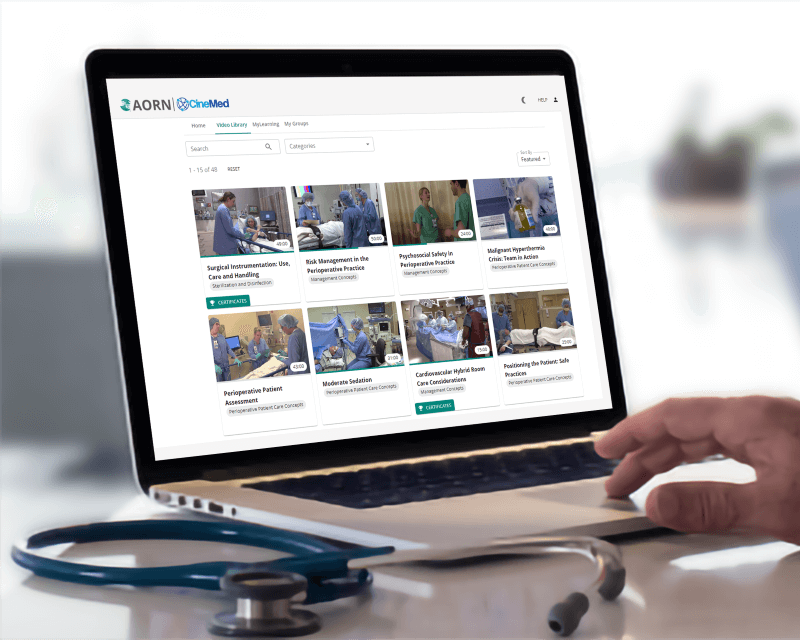
Video Library
Provides the in-depth content: 40-plus courses across the practices teams are trained and evaluated on: infection prevention, sterile technique, patient and worker safety, instrument processing, specialty procedures, professional practice. Each course carries a study guide, a posttest, and contact hours, with continuing education credits available for select online courses. It's how educators onboard, reinforce, and build competency over time.
Review the video library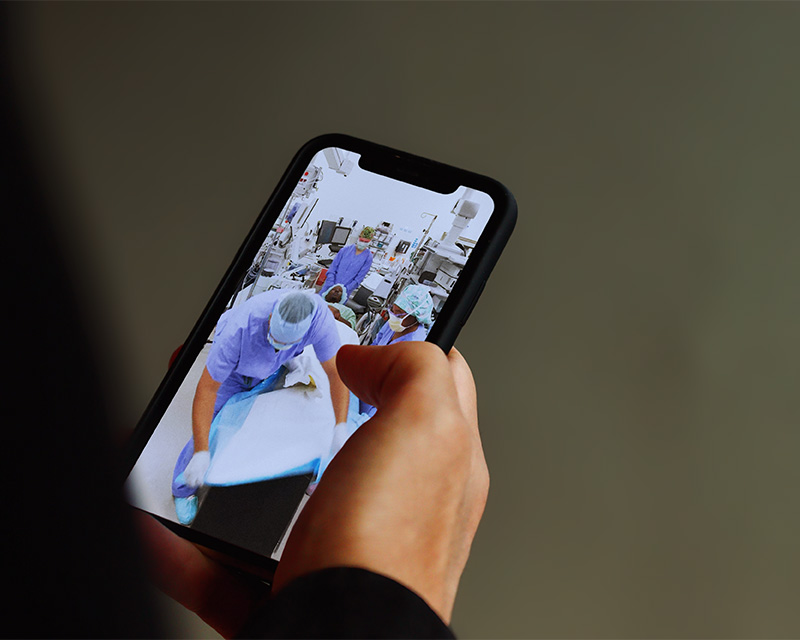
Perioperative Clips
Quick reference videos: 165+ short, single-topic videos a nurse can pull up at the point of need in fast-paced surgical settings. How to prep. How to position. How to drape. Just-in-time learning — demonstration by the book, right when it's needed.
Explore Perioperative ClipsIs AORN CineMed flexible for busy staff?
Yes, it supports learners who work in a fast-paced setting like the operating room and across periop setting. It delivers clear benefits for documentable perioperative staff education, and helps educators align practice across the team. Its video-based courses keep staff development engaging, current with the latest evidence, and documents what learners complete.
How do nurse educators use AORN CineMed day to day?
The educator decides who learns what, and when they want to assign it. They assign what learners need. It's not a one-size course for everyone. New RNs get the fundamentals. Experienced nurses can get more advanced topics for mastery. Everyone works at their own pace, on their own device, between cases or before a shift.
It's asynchronous, so educators can assign video-based learning and decide where they are needed in another room for coverage. And it's one video library to manage — with the peace of mind of knowing AORN's Perioperative Education Specialists keep the content updated, so they don't have to.
Where CineMed fits in your competency program.
Does AORN CineMed replace hands-on competency validation?
No—and it isn't meant to. CineMed supplements the educator's training. Every video includes a study guide and a posttest, so the educator can assess what a learner knows and spot where they need more. They assign courses, sets due dates, and tracks completion for every learner. And because hands-on labs in nursing education practice improve technical skills safely, validation still matters.
The hands-on validation stays with the educator. CineMed gives the team a consistent, evidence-based foundation before assisting in live procedures.
Frequently asked questions about AORN CineMed
The Video Library is 40+ in-depth courses with study guides, posttests, interactive content, and contact hours. Perioperative Clips are 165+ short, single-topic videos for quick reference at the point of need. Periop Clips don't carry contact hours. Use them separately or together.
The Video Library offers 50+ contact hours, awarded on completion of the videos, study guides, posttests, and evaluations. Perioperative Clips do not carry contact hours.
AORN CineMed is staff education for the whole perioperative team, including perioperative registered nurses, across surgical settings and the care continuum in hospitals, ambulatory surgery centers, and healthcare systems through AORN, the Association of perioperative Registered Nurses.
It's an easy way to provide education for the circulating nurses, the scrub nurses, first assistants, surgical technologists, travelers, SPD, infection control, EVS, surgeons, anesthesia professionals, and anyone involved in perioperative duties and care; many nurses find this specialty rewarding despite the fast-paced environment. Nurses find value in training that supports safer, more consistent care.
Yes. Videos include Spanish translations and closed captions, and play on any device.
Educators and learners access course administration and assignments through AORN's learning platform. Get one login for your whole team.
Yes. You can watch sample videos, and an AORN specialist can walk your team through a custom demo built around your program's needs.
Many healthcare facilities combine AORN CineMed with Periop 101 and eGuidelines+ as part of the Perioperative Essentials Bundle. In fact, CineMed videos and Perioperative Clips fit with all AORN education for staff development.
Ask about the Perioperative Essential Bundle.
Periop 101: A Core Curriculum™ is a standardized RN education and onboarding program designed specifically for RNs new to perioperative nursing. Periop 101 is the leading education program trusted by hospitals, ASCs, and healthcare systems to help novice perioperative RNs build foundational knowledge and skills for safe patient care throughout surgical procedures.
eGuidelines Plus provides facility-wide access to the most current AORN Guidelines, clinical tools, and education to support evidence-based practice.
For more information on how bundling these resources can benefit your facility’s budget while strengthening your perioperative team, contact AORN today.
For over 40 years, highly respected healthcare professionals and organizations have relied on CineMed to educate and empower their teams to deliver unparalleled patient care. CineMed provides comprehensive programs at all levels to develop, assess, and retain top talent and cultivate high performing teams to deliver superior patient care.

Reviewed July 2026. AORN CineMed content with contact hours is updated at a minimum of every 2 years to reflect changes in evidence-based practice and the latest research. Additional updates are made sooner if the evidence and research behind the AORN Guidelines changes significantly to warrant an update.
References
- Nasiri Silab A, Fattahi S, Rizevandi P, Mottahedi M. Investigating the effect of video-based training on adherence of surgical positioning standards: a randomized controlled trial. BMC Res Notes. 2024;17:301.
- Clerkin R, Patton D, Moore Z, Nugent L, Avsar P, O'Connor T. What is the impact of video as a teaching method on achieving psychomotor skills in nursing? A systematic review and meta-analysis. Nurse Educ Today. 2022;111:105280.
